Getting Things Straight

Lots of beliefs are hard to shake. Andrew Weatherall covers one from the paediatric airway – the holy status of the straight blade.

As I’ve mentioned before, paediatric airway management is full of mythological beasts. Some of that is about anatomy stuff and the like. Some is about equipment. Plenty is about technique. Sometimes it’s about technique and equipment together. Bliss.

So this is where I wade into another topic in paeds airways:

Straight blades are overrated and you should throw them away.

Marc Zimmer Dog Unicorn Dog
It is a time for mythical beasts. Like the fabled unicorn dog but less cool.

Do we need big bins?

Well, actually no. Stop the indignant letter writing. When I say they’re overrated I don’t mean they have no value. They have a role like most items of equipment that are still in use after nearly 100 years probably still have a role.

What I do mean is that straight blades are treated with a reverence in paediatric airway management that is unwarranted, while curved blades like the Macintosh seem to be described as “bigger people’s airway devices”. Trainees could easily go through their whole training period thinking that you must always use straight blades for patients who understand what the hell Pokemon are all about.

That just isn’t true. People who swear by straight blades will point to the more anterior epiglottis and the angle of the cords to argue the case for their chosen device just as convincingly as those who like a curved blade point out that they get more working space in the mouth and a familiar blade and both will be sort of right.

It might be useful to dive into this a little more. So let’s work through a paper from 2014 that specifically looked at the straight vs curved blade question. Partly because it gives an appropriate ‘meh’ when trying to split the two options but also because it highlights how myths can dominate our perception of the original work.


Welcoming the Contenders

The paper here appeared in Pediatric Anesthesia in 2014 (I touched on this in the other post). The authors set out with a useful question: is there a difference between Miller and Macintosh blades when it comes to ease of obtaining a view and success of intubation in the 1-24 month age range?

They looked at well kids having elective surgery under anaesthesia where muscle relaxation was also used. They included 120 kids and each kid had laryngoscopy with one device then the other.

The results are a case of a big old shrug, which is sort of OK. Easy laryngoscopy was noted in pretty much the same percentages. First pass success pretty much the same. The rates of one being better for the view than the other were pretty much the same. When it was difficult with one view the rate of switching to the other and finding it was easier was about the same regardless of whether you had started with the Macintosh or Miller.

So the two blades that stepped into the ring step out with no knock out punch thrown. There are a number of other interesting points when you look in more detail though and a few comments I’d make in passing.

  1. The epiglottis isn’t the endpoint

I have this impression that trainees get really obsessed needing to pick up and control the epiglottis with a straight blade. In this paper the routine use of the straight blade was to place the tip in the vallecula. In only 2 of the 60 uses of the Miller blade did they pick up the epiglottis.

Why do people get so antsy about picking up the epiglottis? It was only ever described as one of the options to obtain the view, not the only option. Those early designers never forgot the aim: to obtain a view to let you instrument the trachea.

Here’s Miller from the paper where he described his blade:

“The epiglottis is visualized and raised slightly to exposure the cords or, if the operator desires, the tip of the blade maybe placed in front of the epiglottis and raised sufficiently to visualize the cords after the method of Macintosh.”

In fact Macintosh described the straight blade being used in this manner when he reported on his own design, singling out Dr Margaret Hawksley as an exponent of this technique. The authors of this recent paper further point out that it’s a lot more stimulating to pick up the epiglottis. That’s worth at least a thought.

Miller wasn’t precious about how you get the view. The idea that picking up the epiglottis is the only technique just got repeated enough that no one remembers to question it. The epiglottis isn’t the main game. The view is the thing.

  1. Make sure of your basic technique

One of the other interesting features here is that there are some elements of the intubation technique that seem like they could do with a review. An example: the Miller blade was advanced centrally along the tongue. This is a technique taught by heaps of people and I think Miller probably would have strong feelings about that. Again let’s go back to the paper:

“The blade is inserted in the right side of the mouth, pushing the tongue to the left.”

One of the bigger challenges in getting a view in paediatric patients is getting the tongue out of the way. This is particularly for straight blades which tend to have less of a flange to do some of the work for you. I’m not the only one who thinks so, either:

“On passing the instrument into the mouth the tongue should be manipulated to the left side, away from the slot; otherwise the organ may roll into the barrel and completely obstruct the view.”

That was Magill. In 1930. Now Magill might have been describing the use of a speculum but the principle is the same. The tongue is only likely to make your view worse (and given that straight blades pose an additional challenge in having not as much space proximally to work in, that really matters).

Magill went on to point out that if you struggled at all you could move the proximal end of our instrument further to the right corner of the mouth – that’s also known as the paraglossal view and turns out to be pretty much the best way to go.

In other basic technique points the authors of this recent paper mention that laryngoscopy was done with the head in a neutral position. This doesn’t seem like optimal head positioning for use of either blade, and that’s another point worth keeping in mind.

  1. It’s useful to know what the intended use was with your instrument of choice

In this paper and in the comparison with the Cardiff blade they refer to as an example of other “blade vs blade” papers, a comment is made that when you introduce an endotracheal tube centrally you can compromise the view and that it’s not great for introducing your tube via any central channel.

Miller, again:

“The scope is used for visualizing the cords only. One should work outside the blade to insert the tube. The only criticism of the instrument has been that it is too small through which to work. It was not designed to be used as a guide for the catheter.” (That’s the author’s work with the italics, not an edit from me.)

In fact Miller searched for a new design because he felt small laryngoscope blades on the market were too big. It’s designed to be small.

So yes, you need to use a technique where you bring the tube in from the side. That was always the point.

  1. Should we stop talking about external laryngeal manipulation like it’s an extra?

This is really a bit of open musing on my part. This was done in over 50% of the patients in both groups and generally helped when it was used. I can see how the precision of description goes up when we include these details but it strikes me as so much a part of every intubation (as this external pressure means less work for the laryngoscope itself) that I wonder how much it adds to our appreciation of clinical use. That’s one for the comments section I guess.

Messages for the Prehospital or Retrieval Type

After sifting though all of that, what are the take home messages? Well, here are some from me that might need additions from others:

  1. Know what you do and why you do it

Those picking up a laryngoscope for the little people need to have thought through what they will use and why. If I’m offered a personal preference it is to use a curved blade for everyone. Even as a paeds anaesthetist I’ve just used a curved blade more. It’s better designed to control that pesky tongue. You get a huge working space within the mouth and with external laryngeal manipulation (which I’d call standard) you can pretty much always bring the airway into view, even in the slightly anterior larynx.

I haven’t seen a study that would confirm this hunch, but I wonder if one of the problems some prehospital clinicians have with paeds intubation is they pick up a laryngoscope they didn’t really learn, very rarely use or rehearse with and don’t really understand. You need to focus your technique slightly differently with a straight blade. Add the stress of the situation and is it any wonder the job becomes harder?

I’d back the occasional proceduralist as more likely to intuitively understand the anatomy using the same sort of blade they always use. I doubt it’s a study that would be easy to set up in anything but mannequins though.

  1. Know the different options

That preference for people using what they know doesn’t mean you shouldn’t learn both. This study did highlight that some kids just have a better view with a particular blade. You can’t quite get as good a view with one option, switch to the next and all of a sudden it’s easier. Again though if you’re reaching for that other option use it right.

  1. Make your technique appropriate for the 1% and the 99% will be fine

This is more of a general point. Laryngoscopy in infants is easy the vast majority of the time. So if you don’t bother controlling the tongue you’ll probably get by most times. It’s the 1% where your routine practice of not getting the tongue out of your view, or being able to aim for either the vallecula or epiglottis, or positioning the head right will start to bite.

If you always do everything to maximise your view, you’ve already got a good technique for the 1%. It’s best not to need to review your technique once the blade is in and you’ve figured out this is the tough one you’ve been dreading.

So after all that, maybe paediatric airway instrumentation comes down to a really simple refrain: the tool in the hand matters less than the tool holding it.


Notes:

That image comes from Marc Zimmer on flickr under Creative Commons and is unaltered.

Here’s the paper mentioned again:

Varghese E, Kundu R. Does the Miller blade truly provide a better laryngoscopic view and intubating conditions than the Macintosh blade in small children? Pediatric Anesthesia 2014;24:825-9. 

And the others …

A review on the popularity of the Macintosh blade:

Scott J, Baker PA. How did the Macintosh laryngoscope become so popular? Pediatric Anesthesia 2009; 19 (Suppl 1):24-9. 

Miller RA. A new laryngoscope for intubation of infants. Anaesthesiology 1946;7:205-6.

Macintosh RR. A new laryngoscope. Lancet 1943;1:205.

Magill IW. Technique in endotracheal anaesthesia. British Medical Journal 1930;2:817-20.

and the Cardiff paper:
Jones RM, Jones PL, Gildersleve CD, et al. The Cardiff paediatric laryngoscope blade: a comparison with the Miller size 1 and Macintosh size 2 laryngoscope blades. Anaesthesia, 2004;59:1016-9.


Summers Past – A Look Back at Drowning Cases

A quick post on a recent paper from one of the authors, Andrew Weatherall. You can get the full text over here and it might be worth having a quick look at a quick review of a study from the Netherlands that Alan Garner did previously. 

Every summer, for too many summers, prehospital teams at CareFlight go to drownings. Too many drownings. This isn’t to say it’s only summer, but that is definitely when most of the work happens. Sometimes they’re clustered in a way that makes you think there’s some malevolent purpose to it, some malign manipulation of chance striking at families.

And also at our teams, particularly the paramedics, backing up day after day.

So drowning is something we want to understand better. What are we offering? What are our longer term outcomes?

And surprisingly given that drowning has been a long-term feature of preventable tragedy, particularly in Australia, there’s not really that much research out there. In fact it was only in 2002 that clever people at the World Congress on Drowning sat down and agreed on definitions for what was really drowning.

So we set about trying to add at least a little bit to the discussion.

Looking Back

Retrospective research has a bunch of issues. It has a place though when you’re trying to understand your current practice and what you’re actually seeing, rather than just what you think you’re seeing.

We went back and looked at a 5 year period between April 2007 and 2012 (and full credit to co-author Claire Barker who did the majority of that grunt work). For most of this time the tasking system included the HEMS crew observing the computer assisted dispatch system screens. For some of the time there was also a central control person doing this while from March 2011 on there was only the central control person. The aim of the game was to pick up cases where there was an immersion mechanism and either reduced conscious state or CPR and get a team with advanced medical skills moving.

Key points of interest were whether the cases were picked up, what interventions the HEMS team undertook and, if possible, what were the outcomes for those patients? In particular was it possible to glean what their longer term outcomes were?

Things We Found

Up until the move to solely central tasking, all of those at the severe end of the scale (ISS > 15 meaning they had an altered level of consciousness of documented cardiac arrest) were identified for a HEMS team response. Once it went to central control alone, 3 of the relevant 7 were not identified (obviously not super big numbers).

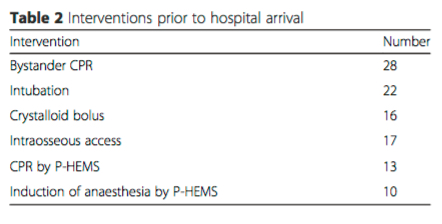
Of the 42 patients transported, 29 of them could be fairly had an ISS > 15 and you can see the interventions in the prehospital setting here:

Table 2 copy

So what were our other findings?

Those who present with GCS 3

This group did not do well. Of the 14 in this group, 10 died within 2 weeks. Of the other 4, one died at 17 months, having had significant neurological impairment after their drowning.

But there was one patient with GCS 3 and a first reported rhythm of asystole that was rated as having normal neurological development on follow-up by the hospital system.

What was different about this kid? How do we make that outlier fit right in the middle?

That’s a nagging question from this study.

9 and above, 8 and below

In our patients, if you had an initial GCS over 8 there was no evidence of new neurological deficit. All the patients with GCS 8 or below were intubated and ventilated by the teams. Every patient with a GCS over 3 when the team arrived survived. All of the survivors (with any initial GCS) had return of spontaneous circulation by the time they were in ED.

Another feature was the neurological outcome for those with an initial GCS between 4 and 7 – 7 of the 8 kids in this group had a good neurological outcome. (One patient had pre-existing neurological impairment but returned to baseline.)

Figure copy

The Bystanders

An observation along the way that is a real highlight. All but one child with a GCS less than 8 on arrival of the HEMS team had received bystander CPR (and that included all of them for those who were systolic). Here’s hoping that marks good community knowledge of what has to be done.

The Stuff We Just Can’t Say

There are the usual issues with retrospective studies here. Some patient may have moved out of area and not had subsequent follow-up. There’s also those three cases of severe drowning not picked up after the change in tasking options after March 2011. As those patients weren’t managed by the reporting HEMS team they don’t make up part of the 42 in this data set. As mentioned in the results, two of those cases went to adult trauma centres first, then were transferred more than 4 hours after the incident to a paeds specialist centre, where they unfortunately passed away. The other case did get a HEMS response by another organisation but we didn’t have detailed access to the treatments undertaken.

Another really important point about the follow-up. The follow-up here is short-term, as it was what is available from the hospitals. It may well be that more subtle neurological impairment only becomes evident as kids get older, particularly when they hit school age. I happen to know that The Children’s Hospital at Westmead has done some work on longer term neurological outcomes which should hopefully hit the public airwaves soon. Intriguingly they’ve looked at kids thought to be entirely neurologically normal and followed them in detail over the longer term. No spoilers in this post but I’ll definitely follow up when it breaks.

It’s also the case that when you’re looking at those who get a HEMS response, you’re not catching the denominator of all drownings. This study doesn’t help us understand what proportion of total drownings end up at this more severe end of the spectrum.

With those provisos, retrospective research still has a key role. It’s still a brick of knowledge. A small brick maybe, but a brick. It’s certainly a better brick to build with than you end up with if you don’t look.

What do we need?

More. Always more data. There is a bit here that suggests things similar to other series, some of which are a good deal bigger. Outcomes after arrest from drowning are better than is generally the case. Our impression is that, as suggested by that Netherlands paper, time does matter and that once you get beyond 30 minutes of resuscitation further efforts are unlikely to help.

The other factor that would appear to make sense (but clearly needs lots of robust research) is that earlier delivery of interventions that should make a difference to outcomes would be good. That surely starts with a big focus on bystander CPR. But that should also be backed up by accurate, early triage of teams with the skills to extend that care. The right teams in the right place at the right time remains the challenge.


Notes:

There’s a comprehensive bit on the tasking stuff in this earlier paper relating to tasking and paeds trauma. It should clarify the different systems used, which can be a bit hard to get your head around.

After the paper came out, @LifeguardsWB asked a pretty reasonable question “What were the average response and transport times?”

So as described in the subsequent tweet, the median times were:

  • Start of emergency call to team on scene = 17 minutes.
  • Time on the scene = 17 minutes.
  • Total prehospital time = 54 minutes.


Collective Podcast Ep 2 – On Traumatic Cardiac Arrest and This and That

Well finally we have a second podcast up. This is a quick chat about an approach to traumatic cardiac arrest, given the recent publication of guidelines we all like to read. The chat features Alan Garner and Andrew Weatherall and also touches on use of the AAJT which was recently added to the plan at CareFlight.

As always feedback, comments and insights from elsewhere would be gratefully received. If you like the podcast you could even consider leaving us a review over at the iTunes site. Or follow the site here to get a friendly e-mail when a post goes up.

Of course there are some notes to go with the podcast.

Alan mentions the HOTTT drill stuff. Here’s the package that goes with it. HOTTT Drill

There’s also a few papers worth looking at for comparison:

The Lockey one.

The Harris one.

The Sherren one.

And the link to the ERC Guidelines.t

Anyway, here it is:

Right click and choose save as to download the podcast. (That’s control-click if you’re on a trusty Mac.)

Or of course you can find it on iTunes.


Things We Say We Love But Never Do

We haven’t had that many chances to chat about something that really matters – analgesia. Here’s a post on things to do with needles by Andrew Weatherall. No acupuncture involved. 

I like drugs. I like the ones that make people drift into their own special ether world. I like the ways they bend light right or left. I like the ones that make vessels open, myocytes contract and gates stay open.

I particularly like the ones that find ways to interrupt pain pathways. Whether they antagonise or agonise (not the best derivation of that word, granted) I am a fan of most of them. This is at least in part because so much of the time we could do better with analgesia. For all the techniques at our disposal and all the agents we have, most often the literature I read on the actual delivery of pain relief would be marked with a “Could do better”.

Despite my broad ranging endorsement of pharmacological agents, when it comes to analgesia, I actually think the best option is sometimes the one that lets you use less drugs.

Which is where regional analgesic techniques really stand out from the bunch.

Providing Clarity

I should really specify a bit. Not all regional techniques seem apt for the prehospital or retrieval environment. For starters I really mean peripheral nerve blockade because the neuraxis just isn’t a place for  a needle in the great outdoors.

And not all techniques are quick enough to make the administration feasible, particularly once you consider the positioning and preparation required.

If there is one block that should be right at the top of everyone’s list though it is the fascia iliaca block to make mute a firing femoral nerve.

Of all the blocks I can think of it is the one that should be a ready-grab technique for most prehospital providers. It is quick to perform. It is reliably effective. It takes away big pain. And I’ve heard people mention it as a great technique lots of times in the cosy space of bases in all sorts of spots.

Yet, whichever way I cut my Medline searches, I get < 50 entries in the literature for prehospital care and fascia iliaca block. And when I mention I’ve used it, I sometimes draw quizzical looks. As if I’d suggested a pot of green tea to the kids at a birthday party.

Yet a well performed peripheral nerve block can mean less of all those other drugs we use for analgesia (particularly the opioids or ketamine) and those agents can have their own issues on occasion.

It tends to provide a better quality of analgesia, along with a patient who has an entirely unclouded sensorium. That super lucid patient can now become a really crucial agent in clinical assessment. At the same time they can be more aware of what’s going on without the distress of pain. I’m inclined to think that a patient who can be reassured and coached effectively through each step probably has a better journey in the long run than the one dozing in and out a bit. I’ve seen patients with both femurs smashed up cracking jokes in the emergency department with their doctors and nurses thanks to functioning nerve blocks.

So is the issue that the technique seems too forbidding? That hardly seems possible.

The Nuts and Bolts

The fascia iliaca technique was first described in the literature by Bernard Dalens, a paediatric anaesthetist. He and his colleagues had gone back to the anatomical drawing board in search of a better femoral nerve block than the ‘3-in-1’ technique. It arose from paeds anaesthesia for a pretty good reason – Dalens was after a block that would work in patients who couldn’t give you good feedback about experiencing paraesthesia, or for whom rationalising the sensation of nerve stimulation might be a bit much.

It’s a while back that this work appeared too – 1989. At the start of 1989, Milli Vanilli were still thought to be a legitimate music act and Rain Man won big at the Oscars. This is not a new technique.

In a comprehensive description of the anatomy involved (complete with radiographic demonstration of local anaesthetic spread) Dalens and crew also report success compared to the ‘3-in-1’ technique – 55 of 59 patients with a successful block of all the nerves they were aiming for (vs only 11 of 51 having block of all the nerve branches in the ‘3-in-1’ group).

They also reported higher first time success rates and less motor blockade. Sounds perfect.

It also just seems more sensible than looking for the femoral nerve. Why approach the nerve with a needle when you can produce the same block with the needle away from the nerve? Why be any closer to the vascular bundle than you need to be? I can’t figure out why you’d bother.

So what are the key points in the technique? (I start with an assumption that as much monitoring as possible is on the patient.)

1. Define the spot for the ‘X’ that marks the spot.

Join the anterior superior iliac spine and the pubic symphysis (draw a line if necessary). Divide it into 3 parts. The mark for where the outer third starts is your staging point. Now drop down a couple of centimetres. There’s your ‘X’. Want a double check? Feel for the femoral pulse. You should be at least a couple of centimetres closer to the edge of your (probably imaginary) bed.

2. Prepare the skin

You still have to be clean. It’s also nice to put a little bit of quick-acting local under the skin to make the rest more pleasant. So wait 1 minute.

3. Use the right needles

I think it helps to make a hole in the skin for the subsequent needle to work through. Sometimes the force required with the short bevel needle makes you really dive through the first ‘pop’ just by the effort to get through the skin. Everything is easier if that resistance at skin level is gone by using a standard needle first.

For the actual procedure, something with a short bevel. It’s the short bevel that lets you feel the two pops. The whole technique (when doing it by feel) relies on the two pops. The first is when you pop through the fascia late. The second is when you pop through fascia iliaca.

My other tips here – once the short bevel needle is through the skin, come right back to almost skin level. You don’t want any doubt as to which is the first pop. Second tip – steady pressure on the needle once you start. Steady pressure leads you to distort the fascia until you suddenly pop through. Then you rest for a second, start your steady pressure again and you’ll feel the sudden give more obviously. If you make short, sharp moves you can fool yourself into thinking you’ve had a pop.

4. Mix the drugs

This one isn’t from Bernard. For prehospital use you do want that block working quickly (that might be less relevant in theatres and maybe even ED). You also have that nagging worry about using solid doses of long-acting agents that might be a bit intractable if they find the heart and cause mischief.

There’s nothing that says you have to use the one agent. I tend to mix in some lignocaine with something longer acting in low concentrations. The longer-acting drug is worth it too – I’ve had patients with a fractured femur get all the way to their operation later in the day without any need for ongoing analgesia.

I'd choose 11 if I could.
I’d choose 11 if I could.

5. Turn up the volume

In the original paper, Dalens used 0.7 mL/kg for the under 20 kg child, working up to 15 mL for those in the 20-30 kg range, 20 mL for 30-40 kg kids, 25 mL for 40-50 kg and 27.5 mL for those over 50 kg (using 1% lignocaine with some adrenaline). The whole idea is spread through a plane, so more is better. I commonly think up to 1 mL/kg, with the local anaesthetic diluted to allow that volume. More volume guarantees spread without dropping speed of onset too much.


Things I don’t do? Well I don’t think using ultrasound adds anything in the prehospital or retrieval context. So I don’t do it. That said the description right here from NYSORA is pretty good.

I do still use it in some patients with other injuries – a block that works and takes away the pain of a femoral fracture, apart from being inherently good for the patient, will still decrease the overall need for analgesia because it’s like one big painful injury didn’t happen.

But What About the Prehospital Space

Well why wouldn’t we do it? Worried about local anaesthetic toxicity? Then use less of the drug. Worried about compartment syndrome? There’s no evidence that having a block changes how often that occurs or causes problems. What I think is pretty clear is that it’s entirely feasible for the prehospital environment.

It’s been described in the care of a 6 year old. Back in 2003 Lopez et al reported use in 27 patients prospectively and saw a big drop in pain scores by the 10 minute mark. 1 block didn’t work. A French group (well, in the abstract as my French isn’t quite that good) report   63 successful blocks in a total series of 107 (other techniques were on the table).

More recently, a group in the Netherlands looked at a process for training the local EMS-nurses in this technique. Their results? 96 of 100 patients had a perfectly working block.

So why isn’t everyone doing it? I couldn’t find good research on that. So maybe it’s just that we spend so much time talking about other options, we forget what is, at its heart,

Or maybe it’s just habit and we need to people to remember there’s nothing about being able to block rapidly firing signals along sensory nerves with drugs in the same loose family as cocaine that shouldn’t be considered sort of astonishing.

Maybe next time there’s a patient with a badly bent femur you could start with a simple question: can I block this pain?

(Pssst … you know the answer already.)

Notes: 

I did a second edit to add a little more description (paragraphs 2 and 3) in the “Use the Right Needle” section. I also added a paragraph to clarify why I’d choose it over the femoral nerve block just before launching into the list of technique tips. It’s the paragraph that starts with “It also just seems more sensible …”

The original Dalens paper is sort of a joy.

Here’s that letter regarding use in a 6 year old.

Here’s the Pubmed link for the Lopez paper.

Here’s the Pubmed link for the French paper.

And here’s the SJTREM paper where they trained up EMS-nurses.

Oh, and to really understand how much can be offered by good regional techniques in retrieval medicine, it’s worth looking up this account of a soldier injured in Iraq. They had most of a calf blown away. With the addition of two nerve catheters (lumbar plexus and sciatic) they had initial debridement and subsequent operations interspersed with multiple long flights to finally make it back to Washington via Germany. All with good pain relief.

The image in this piece is in the Flickr Creative Commons section and is unaltered from the image posted by amp.


Teaching an Old Dog New Tricks – Or A Visit To An Alien Planet

One of the excellent things about retrieval work is the opportunity a clinician is presented with to try new things. Dr Alan Garner reflects on his recent experiences trying out a very particular branch of retrieval medicine – neonates and paediatrics. 

I have recently had the opportunity to do some work with NETS in NSW due to some staffing issues they have had (completely outside their control). For those not familiar with NETS they are the Newborn and Paediatric Emergency Transport Service in New South Wales (NSW). They are busy too, moving about 2700 patients are year, and fielding calls and offering advice on perhaps another 1500. There are also some perceptions out there in New South Wales that NETS cases take a long time, a good part of which is spent in conference calls.

I am an old dog. It is more than 20 years since I passed my fellowship exam and I have never really had much exposure to neonates, particularly significantly prem ones. My ED practice is in a hospital with a high risk obstetric unit and NICU. These patients never come near the ED. So this has been a scary experience for me dealing with patients that might as well be aliens as they bear so little resemblance to what I know. NETS also has a few legends attached. Mostly of long phone calls and even longer jobs. I came to the job keen to see things for myself.

When they’re the scary sort of alien

Some of my colleagues from CareFlight who are also helping out on the NETS roster are paediatric anaesthetists in their non-retrieval life. The first solo NETS shift that any of us did was by one of my paed anaesthetic colleagues. She was sent to a neonate with severe meconium aspiration in a metropolitan hospital in Sydney. After intubation and ventilation on 100% O2 the baby had airway pressures in the 40s, an unmeasurable tidal volume and pre-ductal saturations of 80. I had nightmares that night wondering what I had got myself into and feeling completely out of my depth.

Despite my initial terror I still managed to front up for my first shift and discovered that my colleague’s patient was possibly the sickest NETS had moved all year. Slightly calmer now I have survived several shifts and thought it might be time to give the old dog’s perspective of the alien landscape I have found myself in.

Describing other planets

For all the adult retrievalists out there that dabble in some paediatrics i.e. people like me, let me try and explain what it is like. Imagine a service set up to do only interhospital transports of patients with respiratory failure. There would be lots of people with COPD and asthma, pneumonia and ARDS. For the first two groups you might spend hours at the scene stabilising a patient on NIV before feeling it is safe to move them.

This represents excellent care as we know that once they are intubated the mortality rises sharply. Same with the pneumonia and ARDS patients – good critical care at the referring site is what it is all about and may even include getting an ECMO team to them. There is absolutely nothing time critical about moving any of them and it would indeed be poor practice to attempt to move them too early.

Now if you have been able to imagine such a service, this is what the population that NETS transports is overwhelmingly like. There is rarely any time critical intervention waiting at the receiving hospital, and getting them stable for transport can take a very long time. Neonates with hyaline membrane disease are the absolutely classic example of the stay and play patient. Intubate them, give some surfactant then wait for it to work. This is excellent management for these patients.

And you also have to understand how physiologically brittle these little creatures are. Just give them a poke and their sats are 70% (you think I am exaggerating). You really want to be sure that you have some sort of stability before you start bouncing a patient like this around in a moving vehicle.

The smallest patient that I have moved was 950gms. The only reason that I agreed to do the move was the kid was basically OK and was being moved from a NICU associated with a paediatric hospital to one closer to the family’s home so that another baby that needed paediatric surgical input could be accommodated.

This baby was “well” with just some air running by high flow nasal prongs. However if you picked him up, he cried or you shook him about (in a moving vehicle) his sats were high 70s/low 80s. And this was a well baby by their definition. The nurse I was with did a fantastic job (thanks Charlotte!) and I did my best to not look like I was getting in the way.

Space and time

For those that think NETS take a long time then you just really don’t get the patient population they deal with. There is no urgent interventional cardiology or transport to stroke centres. There is no parallel in their alternate universe to these patients from the adult world. The closest they get is trauma patients. Trauma however is a tiny proportion of the caseload, and the trend is increasingly to non-operative management wherever possible anyway. I have been hoping to do a trauma case when I have been working for NETS as that is right in my comfort zone. However there have not been any for me to do. Rather it has been lots of prem and term babies, and infants with either respiratory issues or seizures. The one nagging question I have is how a system more used to steady movement of a patient springs into action when they really do have to push it along. A bit more time and I might get to see that too.

Not those sorts of alien but there is a link to phoning home sort of ...
Not those sorts of alien but there is a link to phoning home sort of …

Connecting Across Space

As a team member I have also had the opportunity to listen in to a lot of coordination calls. NETS coordination is a bit of a legend in NSW and rightly so. With a NETS transfer everyone at both ends (and the retrievalists in the middle) is involved in the initial conference call, and often any update calls along the way. And they can be long calls. There is a big plus though everyone knows what the plan is and they own it.

Just last week I was visiting one of the paediatric trauma hospitals in Sydney and they were lamenting that this is sometimes not the case when the adult system was moving a severely injured child, where it’s always been the case that the retrieval team takes the job and gets on with the job. That’s just how it’s been for as long as I’ve been around. They did not know what was happening or when the child would arrive. This is never the case with the NETS system. Although this theoretically is supposed to be the case in the adult world too there are lots of instances where it just does not happen unfortunately (I take as a reference point this report).

People find it easy to point out flaws with their approach, but I think the NETS coord system has several strengths:

  1. NETS encourage the concept of “there is no dumb question” for all the non-paediatric hospitals in NSW. NETS accept that they will field some silly stuff that should probably never have got to them so that they don’t miss any child who really is sick. For the low level stuff they patiently patch the caller in with the local paediatrician (sometimes in the hospital the caller is in) so that the local systems can manage the case wherever possible.
  2. An extension of this is they look for the nearest solution to the problem and don’t assume that a call equates to a request for transport. Getting the right people involved locally can often solve a problem locally. Or the closest solution for the patient might be a service somewhere else like across a state border.
  3. As they work at finding the best solution for the patient, all the players talk together to agree and own the plan. As I have already said, there is never any confusion about who is doing what on a case that NETS coordinate.
  4. The nurses who coordinate the calls at NETS are actually moving babies themselves the day before and after. They know all the logistical and clinical challenges as coordination and transport are both part of the same job. It is notable that London HEMS has a dispatch system which works because the dispatchers are paramedics who work on the helicopter as part of the same job. I don’t think this a coincidence.

Retrieving Little Aliens Produces Other Big Challenges

If NETS has a weakness compared with the adult services it is perhaps the fact that not many of their cases are done by specialists except when they are coaching new registrars. Particularly on the neonatal front some of the babies are fiendishly difficult to stabilise adequately for transport (like the first case done by my poor anaesthetic colleague mentioned above). They really need a consultant neonatologist for these cases as they seriously stretch the capabilities of both the humans and machines (see below) involved in caring for them. Perhaps an unexpected bonus of the recent challenges in staffing will be a few extra specialists in the shift mix seeing as the whole team benefits from their experience when they’re online.

Another issue is the equipment. Across all age groups NETS currently have four different ventilators which is a bit of a nightmare for new registrars coming into their system (although the skill of the nurses is a big mitigator here). Over the years as they have added new lines to the roster to keep up with increasing demand, they have added just enough equipment to keep up without retiring any of the old stuff. Some of the ventilators date from the 1980s. Although they still work, you would not find a machine of that vintage operating in an intensive care unit anywhere in NSW.

Infants are a particular problem. They have some Oxylog 3000 +s but they just will not ventilate a child with an ETT less than 4.5mm diameter and they struggle with bigger kids too if they have any lung pathology. There are newer turbine transport ventilators out there that can deliver a 2ml tidal volume and also ventilate a 100kg 15 year old. One ventilator could do the lot which would significantly decrease the training burden and hence increase patient safety too.

It will take a cash injection to fix this I suspect and it is not just buying the ventilators. The neonatal systems and paediatric bridges will need modification to mount the ventilators and in the aeromedical environment that means engineering certifications etc. etc. No cheap fix here. I understand this is currently being investigated but it can’t come soon enough.

And a final comment on the staff. As I am doctor, I have not had the chance to work directly with many of the NETS doctors as the standard team is doctor/nurse. I have now worked with a number of the nurses though and have been really impressed with their professionalism. It should be obvious from the caseload that I have described above that the little details really matter with these patients.

Like all good critical care nurses the NETS nurses have just the right level of OCD to be obsessive about the stuff that matters, but not quite enough to drive you nuts. I have been impressed with the risk management approach and planning, like discussing best and worst case scenarios with appropriate plans for each on the way to every case.

For me this has been a real learning experience. I am still way out of my comfort zone but hopefully there is still room for a new trick or two from the old dog.

Notes and References:

Here’s that CEC report on Retrieval and Interhospital Transfer again.

The image here is from the Flickr Creative Commons area (unaltered) and was posted originally by JD Hancock.

In the meantime, Alan can’t be the only one who has found something that really challenged them recently. Any stories to share? There are comments for that.


Reports from the Top End – ASA Highlights Reel

Continuing the posts arising from the ASA conference (not the anaesthetics one, the Aeromed one), we share thoughts from just a few attendees with th esessions that proved to be a highlight. 

The Northern Territory is known for many things. Even some things that aren’t related to crocodiles. Just recently it also hosted the annual conference for the Aeromedical Society of Australia. It’s a good choice as host location because retrieval around the Top End tests clever professionals in very particular ways.

There’s also a good proportion of the year where the northern climes of Australia are weighed down with the collected sweat of tropical sauna season. So any visit outside those times is well worth it.

As CareFlight provides retrieval services around Darwin, there were plenty of the crew who got along. We asked three to nominate a couple of the bits that most tickled their interest.


Dr Toby Fogg, CareFlight Medical Director

Amongst lots of great talks, the talks from Dr Russell McDonald, who hails from Canada and works with ORNGE, were particularly fascinating.

One of these, with the title “The Glue That Binds – Patient Transport in Regionalised, Rural and Remote Healthcare” looked at the pros and cons of regional services vs centralized services with more retrieval. There was a lot that felt familiar about the description of a big country with vast spaces between people.

Russell made the point that regionalisation reduces duplication of expensive infrastructure and increases case load in those centres, thus improving outcomes. Having big centres means patients who are very ill will need to be transferred. He quoted a figure for errors on these transfers – 1 in 6. (Those are Russian roulette numbers.)

1 in 6 is a very high number (though he didn’t define exactly what the errors were, which would have been a bit of extra detail I would have liked). These errors are more common and potentially more likely to result in big problems where the transport involves inotropes, intubated patients, haemodynamic instability or longer transport times. I guess that only covers pretty much every retrieval in the remote top end.

The potential downside of regionalization is seen in the smaller communities. Building up big centres can easily lead to loss of local services. This makes a safe and timely transport service critical. For such a service to work, it really needs to be fully integrated into the system.


One of the other highlights was a talk from Dr Andrew Pearce. Andrew is the Clinical Director of Education and Training at MEDSTAR (operating in South Australia). His topic du jour was “Advances in Prehospital and Retrieval Medicine” and he took it as a chance to sample broadly from the smorgasbord that offered.

He opened up with a bit of chat about the role of social media in education. In particular he spoke a little on the need to apply a bit of critical reasoning in the social media space like any other area we learn medicine. There’s some good information out there but it’s not universally excellent (disclaimer: except for everything on this site – everything here is top notch). A key question he left behind: are our trainees accessing the right information and following up by going back to the source?

Andrew also touched on prehospital REBOA in the MEDSTAR context. As many reading this (yes, via social media) would know this is already in use by London HEMS. For remote spots in Australia though it’s less clear if there is much of a role. In pig models the ischaemic time in pig models is a maximum of 50—60 minutes. In humans it seems to be 20-30 minutes. For many operating in the Australian space, there is no prospect of completing the journey to hospital within this time frame. All of that before you even get to the issues of adequate case load and how to train.


Jodie Martin, Clinical Educator, CareFlight NT Operations

If there was one thing I took away from this conference it was the continuing focus on human factors and CRM. Everyone seems to have taken the message that we can’t forget the human bit in medicine and make it integral to what they do.

When it came to the talks my highlight was Dr Andrew Pearce talking about advances in prehospital medicine. He talked about fancy stuff but emphasised that if you don’t do the basics well and compliment that with great team work all the shiny stuff is worthless. The basics. Do them and do them well. (I am a big fan of basics.)

I also found the talk from Andrew Duma, Senior Base Pilot with Air Ambulance NSW thought provoking. He broached a topic about clinical currencies of medical crews. That was fairly game of a pilot I thought. He pointed out that aviators have a range of currencies to update and proficiency tests to reaffirm that those core elements of the job are up to scratch. Should there be an agreed approach to make this stuff universal for clinical staff across all jurisdictions as well? (More educators to deliver on that would also come in handy of course.)

It just seemed like there had to be a crocodile in here somewhere.


Jodie Mills, Senior Flight Nurse/Midwife (Research and Quality), CareFlight NT Operations

I also really enjoyed the “doing the basics better” approach from Dr Andrew Pearce. It’s the cornerstone of good practice in my book.

The other standout presentation for me was from SAAS MedStar Kids on the topic of thermoregulation of outborn neonates. Obviously I’m partly interested because it can be directly related to our practice in Darwin.

The incidence of neonatal complications due to hypothermia is most likely underreported. Temperature is a good KPI for neonatal retrieval, as was covered by Naomi Spotswood.

SAAS MedStar Kids conducted an audit and were able to implement measures to decrease the incidence of outborn neonates arriving at their destination hypothermic. By instituting core temperature measurement (which they did via rectal temperature monitoring) and charging cots at 350C they were able to ensure 100% of outborn neonates were delivered to the receiving centres normothermic. 100% success is what we all want from our targets.


So there you go. Did you see a theme? No, not the Pearce-related theme, though that was sort of a theme too. When it comes to delivering the best health across the vast tracts of space we deal with in Australia, it is vital to do the basic stuff right, every time. The tech that does so much more than bing goes nowhere without good basics.

And of course the team. All delivered by a good team. Relevant to med. Probably relevant to dealing with crocodiles at a guess.


Notes:

The image here was on the flickr Creative Commons area and is an amazing image (which is here in an unaltered format) by Alexander Cahlenstein.

Reports from the Top End – The TriClinicians Cup

Recently the Aeromedical Society of Australia had their annual conference up in Darwin. This is the first of a few posts arising from people who got there – Dr Sam Bendall with a report from sim land. 

I love the way simulation brings people together. All aeromedical services use simulation as a training tool and that familiarity allows fun to be had and challenges to be set in the form of the 3rd annual ASA & FNA Simulation Cup.

The Getting Ready

It’s quite tricky putting together scenarios that will work for different team configurations and will be fun but enough of a challenge. We also had to be super careful to keep everything under wraps to keep it fair, so only 4 of us from NSW knew anything about it. I have enormous respect for my predecessor in organizing the Simulation Cup – Ben Meadley from Ambulance Victoria. He was unfortunately unable to make it this year but he was always on hand to provide guidance and advice in putting together this challenge. Thanks a million Ben! Kate Smith, the conference organiser, and her team were incredibly flexible and happy to work around the simulation craziness…. you want to what…. where ….. and with THAT??? allllrrriiight 🙂

Our logistics team was once again truly awesome – they are completely unflappable. Despite doing 3 training events in 2 weeks in different states, they not only transported several tonnes of gear to and from Darwin, but also helped in the scenarios and sorted out transporting it all back! Legends (and a double 🙂 for that).

We do a great deal of simulation at CareFlight and we are lucky enough to have some pretty cool toys, dreamed up and provided by our amazing Logistic and Events team. The newest addition to the stable is the NT crash car simulator. We have had version 1 and 2 in NSW for some time, but this one is new to the NT team so it had to have an outing.

It's cool and all but the engine could use some work.
It’s cool and all but the engine could use some work.

The Teams

Three teams competed in the heats – Cheah and his team from Malaysia (who did their scenario in English AND their native tongue), MedSTAR and CareFlight NT. The CareFlight NT and MedSTAR teams went through to the finals that were held at the end of the conference on Friday. Spectators grabbed a cold beverage and most of the delegates came down to support the two teams – a fantastic audience turnout.

Four members of the Northern Territory Emergency Service came to help out and add fidelity to the final scenarios. Gary and his team were happy to help out and be the rescue service in both scenarios. Many of the NTES folks have done the CareFlight Trauma Care Workshops so it was great to have another opportunity to train together.

Game Time

The first scenario saw the CareFlight NT team managing two patients in a Motor Vehicle crash. Their CRM was awesome and they were so calm it was amazing. They even found Chelsea, the puppy!

The second scenario saw the MedSTAR team managing a patient who was impaled on a construction site and bleeding heavily, and another injured construction worker. They too had great communication skills and did a good job of managing their patients. At the end of the day, the scores were close but the MedSTAR team was the winner on the day – NICE WORK TEAM 🙂

It takes an enormous amount of courage to get up in front of your peers and compete in a simulation challenge. It tests your CRM skills, your ability to function under pressure and your ability to treat patients as a team. Thank you to all three teams to stepped up to the plate. You are all incredible and it was a privilege to see you all in action.

Till next time …… bring on Queenstown (which btw, is my FAVOURITE place on earth!)…

QT copy

It Takes a Team

This entry could not pass without a big thanks to the following people who helped us out enormously with the Simulation Cup:

  • Kate Smith and her team – for everything!
  • Ben Meadley – for all his support and advice
  • Melinda Riall from Limbs and Things – provided the Suture Tutor prize for the Simulation Cup Final
  • Anthony Lewis – for providing an iSimulate unit for use in the scenarios
  • Stacey Williams from Zoll – for providing a defibrillator for use in the scenarios
  • NTES – Mark Fishlock, Gary and their team
  • The judges (some of whom were co-opted at very short notice – thank you J:
    • Mary Morgan – Hunter & New England Retrieval Service
    • Anthony De Wit – Ambulance Victoria
    • Paul Gallagher – NET
    • Andrew Pearce – MedSTAR
    • Emmeline Finn – CareFlight QLD
    • Andrew Duma – RFDS Sydney
    • Lachlan Beattie – NSW Ambulance
    • Lindsay Court – NSW Ambulance
  • Martin Dal Santo – CareFlight Logistics Team – he made EVERYTHING work!
  • Don Kemble – Manager Facilities and Logistics CareFlight – Enormously helpful with planning and logistics.
  • Ken Harrison – outstanding confederate performances – thank you
  • Richard Potts – AV guru from Kate’s team
  • Kellie Robertson, Danny Hickey and the AV team from the Darwin Convention Centre
  • Sarah and Ursula – fabulous coordinators from the DCC
  • Justin Treble, Elwyn Poynter and the rest of our fabulous education team – for all your help at the last minute making technology work and packing up!

Does video make for little airway stars?

Most of us are always out for new techniques to make difficult cases easier. Videolaryngoscopy is one area of great change over the last decade. Here Andrew Weatherall looks at videolaryngoscopy as it relates to looking after the little kidlet airway. 

Seeing is believing. It can happen in a moment in sport. It’s the whole basis of magicians plying their trade.  Even people seeing mysterious circles appearing in crops want to believe.

Perhaps that impulse is why everyone wants to believe in videolaryngoscopy. And it makes sense. It’s persuasive. The view is better than your eyes alone. It must be better.

And yet … the evidence doesn’t help us back up our gut reaction. So the debate starts. It’s a pretty big debate too. Too big for here.

So let’s just talk about one bit. Let’s see where videolaryngoscopy fits in with kids.

Open Bias

I should declare an interest here. I like videolaryngoscopy. I work in operating theatres where it’s freely available. In our prehospital operation we use it as routine. This is not to say I don’t dig direct laryngoscopy. I just really like an intubating experience that’s a little more IMAX. That isn’t even because I’m particularly a gear junkie. I’m only interested in tech if it helps me do a better job looking after patients.

So what’s so great about videolaryngoscopy? It’s not the view that it gives. It’s the team that it gives. My subjective experience is that when taking on a  slightly challenging airway the greatest benefit of using videolaryngoscopy is that all members of the team managing the airway can appreciate what is going on.

Sharing the same vision is the quickest way to get everybody operating on the same page. It’s particularly beneficial in getting any airway assistant providing external laryngeal manipulation to line up the view in the best possible way.

These observations are the same ones that colleagues who are fans of videolaryngoscopy seem to make. They note some drawbacks too. (blood in the airway being the obvious one). More and more though, videolaryngoscopy is perceived as the go to option for the extra few % that makes intubation a sure thing.

So does the evidence match that perception? And if not, why not?

What’s the Problem?

Perhaps it’s worth remembering that difficult intubation in kids isn’t that common. Some of the morphological changes that might be associated with difficult intubation are relatively common on their own. Restrictions to neck extension, a small mouth and jaw, a big tongue and dysmorphic appearance may be associated with difficult intubation. Of course most with these features still have a straightforward intubation.

A team from Erlangen published a retrospective review not that long ago looking at this issue. Looking back over a period of 5 years (while excluding records that were incomplete or where intubation wasn’t relevant) they ended up looking at 8434 patients who had a total of 11219 procedures.  152 (1.35%) of direct laryngoscopies were classified as difficult laryngoscopies (grade III or IV views).

1.35% isn’t much. Note also that they are talking about laryngoscopy, not actual intubation or airway management. Certain surgery groups had a relatively higher rate (oromaxillofacial and cardiac surgery patients) as did kids under the age of 1. The wash-up is that if we were to choose videolaryngoscopy to help with difficult laryngoscopy, we’re choosing that for < 2% of the population. This choice is fine but we at least need to understand the size of the problem we’re trying to address.

The 2% is something like the size of one of the eggs vs that ginormous bug.

The Numbers For VL

Well they’re in and they’re not particularly supportive of the idea that videolaryngoscopy in kids is vastly better. Here’s one study where Truview PCD and Glidescope didn’t help with the view and slowed things down. Here’s another small series where the Glidescope doesn’t necessarily help with the view.

Of course rather than keep picking out individual studies, we could try to take on board the evidence from a meta-analysis. Sun et al have done the hard work, looking at fourteen studies which had a randomised component to their study.

Their findings? Videolaryngoscopy generally improved the view of the airway in kids with normal airways or potentially difficult airways. However the time to intubation was longer in pretty much all groups. Interestingly, the rate of failure was much higher with videolaryngoscopy (there was lots of heterogeneity in the included studies so that particular finding probably needs more than a few grinds of the giant salt mill).

Cochrane has a review specifically in neonates which is useful … to demonstrate that there’s not enough useful evidence.

What Don’t the Studies Say?

Well it already looks like the answer is “much”. Perhaps this is what I take away from them.

1. The evidence doesn’t justify a move away from direct laryngoscopy

I think videolaryngoscopy is still best considered as a technique to use as an adjunct, building off really good direct laryngoscopy technique. If the spiel is that VL “improves your view by one Cormack and Lehane grade” then implicit in that is the assumption that your view was already optimised.

For the vast majority of patients who have a grade I/POGO 100 laryngoscopy, videolaryngoscopy can’t improve your view (obviously). However you may reach the same view with slightly more ease. This applies particularly to videolaryngoscopy options that build off a standard laryngoscope design (rather than the Glidescope for example which has its own special learning curve).

Wouldn’t logic say if you need to work less to achieve grade I, II or even III views, your technique runs the risk of becoming reliant on the extra % that videolaryngoscopy gives you? For video laryngoscopes that operate pretty much like standard laryngoscopes with a little bit extra, you need your technique with direct laryngoscopy to get you most of the way there. The “video” bit is for the last few percent.

So good training in direct laryngoscopy techniques remains vital.  Practitioners will still need to understand the difference in technique required for different laryngoscopes and what the implications are for patient positioning to optimise success rates.

2. More nuance in the research would be helpful

Meta-analysis relies on the contributing papers. There’s presently a bit of heterogeneity there, including in the level of experience in those using the devices. Follow-up studies (or just fresh studies) when people have become highly used to videolaryngoscopy would be an interesting addition to the literature – how long does proficiency take to develop?

What about managing the unanticipated difficult airway case? That seems to be a whole area that isn’t well addressed by the current literature. Or measurement of decision-making and overall management of the airway when videolaryngoscopy is available?

There’s also a tendency to focus on clumps of trees rather than the whole forest. This is pretty common to airway papers. Often the focus seems to be on ‘time to tracheal intubation’ (which isn’t the worst surrogate to choose) or, less productively, on the view of the glottis or first pass success. This touches on the same territory discussed by Alan Garner here on measuring surrogates rather than clinically meaningful parameters.

Seeing the glottis more doesn’t equate to the airway being managed.  First pass success isn’t the most vital of measures. Time to tracheal intubation from laryngoscope in hand might be a little more helpful, but is it more useful than time from induction to airway secure in the patient with a difficult airway? Should we be reporting on desaturation rates with one technique over another given that the aim of airway management isn’t just the bit of plastic?

3. Measuring teams

The other feature the literature doesn’t inform is that subjective sense of utilising the team better in difficult airway management. It would be really interesting to see some research that examined the impact of videolaryngoscopy on the ways teams worked together or communicated in the management of the airway. Or what about performance of teams managing the airway in out of theatre locations? As things stand the thing I subjectively feel is the best feature of videolaryngoscopy doesn’t seem to have been evaluated.


So where does that leave me? Not really anywhere different. Probably where it leaves me is in need of checking my own position on the seeing vs believing spectrum.

In the absence of evidence from other people I should probably rigorously examine my personal practice. Practice the use of different techniques until I feel proficient. Then measure my actual performance and see what my own benchmark performances are. Perhaps really rigorous personal auditing (not the Scientology version) is the next step in understanding how VL should fit into my practice and how it measures up to DL.

It’s only after that that I’ll really know if I’m seeing what I think I’m seeing.


The References:

Heinrich S, Birkholz T, Ihmsen H, Irouschek A, Ackermann A, Schmidt J. Incidence and predictors of difficult laryngoscopy in 11,219 pediatric anesthesia procedures. Pediatr Anesth. 2012;22:729-36.

Riveros R, Sung W, Sessler DI, Sanchez IP,  Mendoza ML, Mascha EJ, Niezgoda J. Comparison of the Truview PCD and the GlideScope video laryngoscopes with direct laryngoscopy in pediatric patients: a randomised trial. Can J Anesth 2013;60:450-7.

Lee JH, Park YH, Byon HJ, Han WK, Kim HS, Kim CS, Kim JT. A Comparative Trial of the GlideScope Video Laryngoscope to Direct Laryngoscope in Children with Difficult Direct Laryngoscopy and an Evaluation of the Effect of Blade Size. Anesth Analg 2013;117:176-81.

Sun Y, Lu Y, Huang Y, Jiang H. Pediatric video laryngoscope versus direct laryngoscope: a meta-analysis of randomized controlled trials. Pediatr Anesth. 2014;24:1056-65.

Lingappan K, Arnold JL, Shaw TL, Fernandes CJ, Pammi M. Videolaryngoscopy versus direct laryngoscopy for tracheal intubatio in neonates (Review) Cochrane Database of Systematic Reviews 2015. dii: 10.1002/14651858.

Over on Minh Le Cong’s site, he’s also previously shared something a little more positive on videolaryngoscopy.

The image here came from Flickr Creative Commons and is unaltered. It was posted by Alibi 0591.

Chat about Chests – On Holes and Whether Plastic is Fantastic

Dr Andrew Weatherall with an introduction to a new type of thing (well, for this site anyway). 

*Ahem* [clears throat].

Well, we finally thought we should try chatting. After much delay we finally sat down and tried recording a chat with a microphone. And then after a much longer delay I have finally spent some time learning what to do with all that noise. All that slightly-too-quick-talking noise.

This effort features me chatting with Dr Alan Garner about those times you need to decompress the pleural space. It seems to be an area where a lot of people have passionate ideas about how and when to intervene. This makes it ideal for a chat, although maybe harder to be definitive about what to do. While Alan makes the argument that many of the disadvantages of tube thoracostomy first solved by the open technique have other solutions apparent in modern practice. However, all the options have some advantages and disadvantages, benefits and complications. That’s part of why it’s such an interesting topic.

This would be the point for  a tenuous link to the concept of lying back and enjoying the talk like this otter. It's just an excuse to share the otter.
This would be the point for a tenuous link to the concept of lying back and enjoying the talk like this otter. It’s just an excuse to share the otter.

So here is our first podcast for download (or here’s the permalink or the whole player thing). We sort of hope it will lead to plenty of associated convivial coffee-based chats.

I do need to share some extra bits of information, because it turns out 30 minutes of chatting still leaves some things unsaid:

  • This is very much a learning thing at this end. So if there’s a few rough bits in the audio/recording and the like feel free to send some constructive feedback. Promise to get better at it.
  • This chat actually happened way back in December (!!!) so apologies for taking this long to get it together. What that does mean is there’s a couple of bits that need an update – most particularly that the good Dr Garner has moved on from the Medical Director position at CareFlight. The excellent Dr Toby Fogg does that now (while Alan is still working pretty much as hard as ever, just not everywhere all at once).
  • At the end of the podcast, we have a chat about the need for research. Well I don’t know if that got him moving but Alan is now putting together a retrospective study involving lots of centres and services across Sydney. Hopefully this will provide some more evidence to add to the mix and inform how to do future research better.

Now some papers are mentioned by Dr Garner as he goes along. So,

As a bonus, here’s a reference for one looking at tube thoracostomy placement (as in whether it ends up in the right place, which was the case for 78%) which sort of highlights the importance of choosing the right bit of kit and being trained well:

Oh, and as a tracheal tube is sometimes suggested as an alternative to an intercostal catheter, it’s worth looking up this recent letter to the editor from Emergency Medicine Australasia, where a patient was unstable during transport with a tracheal tube in place to maintain the thoracostomy and subsequent investigation in hospital showed it had migrated. Yep, all techniques have their problems.

Addition:

Minh Le Cong reminded me that the draft NICE guidelines relating to trauma are up for people to comment on and obviously mention chest injury amongst many other things. Well worth a look (possibly via the excellent summary by Natalie May at St Emlyn’s.

Hope you enjoy it.

Wait, there’s some more acknowledgements:

A big thanks to Dr Minh Le Cong for the encouragement and advice. 

We tried out two bits of music for this podcast and they were sourced from the lovely Podington Bear at the Free Music Archive. The first is ‘Mute Groove’ off the ‘Equatorial’ album. The end track is ‘Dole it Out’ from the album ‘Grit’. 

Along the way I also picked up many useful tips from Joel Werner and Samuel Webster (disclosure: the good Mr Webster is my brother-in-law but is quite a good artist and everything person and I suspect I would have come across his work anyway). 

The image here was from the flickr Creative Commons area and shared by Peter Trimming. It isn’t altered. 

Fidelity – can you have too much of a good thing?

Finally Dr Sam Bendall returns with another post on things educational. This time around it’s about how to focus on fidelity. You can read Sam’s earlier post right about here

The human mind is a complex machine. I am constantly amazed at its ability to “fill in the gaps” or create a reality. Like …. I was SURE I saw my keys on the bench this morning.

This is not a post about drug-altered states. (By Rob Gonsalves.)

Fortunately for those of us who love simulation as a teaching tool, this amazing ability can be exploited to create realism in our scenarios.

So this then begs the question, if the most powerful simulator in the world is on top of your neck, capable of filling in many environmental deficits, how much external fidelity do we really need? I love Dr. Cliff Reid’s line: “Run resuscitation scenarios in the highest fidelity simulator in the known universe.. your human brain.” (you can check out the related talk here). So how do you get other people’s brains working for you in your simulation?

Searching High and Low

In doing a little research for this post, I was curious to see what others felt constituted high fidelity vs low fidelity simulation. In many sources it was simply to do with how technologically fabulous the manikin was. No mention of recreating key environmental stimuli. No mention of inserting the human factors elements that play out repeatedly in any microcosm. No mention of recreating other sensory or physical cues that affect the way we behave in any given situation and affect our decision making.

The über end of the spectrum is virtual reality – full recreation of the all the visual stimuli you would ever encounter in any situation, sometimes involving goggles. Maybe something like this Virtual reality “cave” simulator.

Now some folks may thing that is amazing, and in my humble opinion the graphics are amazing. But how often do you treat patients with goggles on and by waving a wand thing at a wall? If you do…. well there is olanzapine for that. Last time I looked we also don’t work in a three-sided 3m x 3m box.

Actually these are just this guy's sunglasses. [via wired.com]
Actually these are just this guy’s sunglasses. [via wired.com]
The Experiences Where You Gain Experience

So lets take a step back. Think about your most memorable experiences – positive or negative. What are the details of those experiences that caused them to be so strongly imprinted in your mind? Was it the smell? The fact that you were freezing cold? Was it to do with touch? Chances are, it was not just the view in front of you.

Now think back on the medical cases you remember. What is now stuck in your mind about them? Was it the sound of the pulse oximeter descending into the basement where hypoxia hides? Was it the conflict going on in the resus bay? Was it the difficulty you had getting a piece of equipment to work?

I put it to you that THIS is the stuff we remember. If we are using simulation as a teaching tool, we want our participants to remember what they learnt so that they can apply it when it counts. So we have to make it memorable. Perhaps we need to rethink exactly what fidelity means in simulation…

I am fortunate to work with someone I consider to be a master of simulation, Dr Ken Harrison. By making the smallest tweaks, he can add a whole new aspect to the scenario and increase the fidelity for the participants that little bit more. Usually the cost involved in making the scenarios highly memorable is about $0.

I did his scenarios many years ago as a participant in the CareFlight Pre-Hospital Trauma Course, the first of which ran as a trial in 2001 (not with me attending) after years before that of employing simulation in education.

I can still remember being cold. I can still remember making a cluster of our environment. I have never forgotten the lessons I learned from those as the necessary fidelity was there, even though the manikin was a Resusci Annie simulator, the monitor was a billion year old defibrillator and the Thomas packs we were using were generic. No lights, no camera, no creepy goggles. Just the cold of the ground reminding me to wear warm stuff on jobs, the difficulty in getting unfamiliar equipment to work (know your equipment) and the difficulty in getting to the head of the patient because of the tree we had centred quite nicely in our workspace.

These are lessons I have not forgotten and things I will not repeat. All this by simply setting up a scenario on the side of a moderate embankment that our minds turned into  a 100 ft cliff, on a chilly July day. Job done I reckon!

The Bits You Need to Stick

So in considering where to invest your money, time and energy in creating fidelity in your simulation ask yourself this:

What is it about this scenario that I want my trainees to remember vividly in six months time when they will really need it?

For example I want my trainees first and foremost to stay safe on the job. There are a variety of hazards in the pre-hospital environment, some of which will kill you. Like this one.

This is not a recommended way to remember where your car is. [via Springfield New Sun]
Do I need to connect the car simulator to a 12V battery to teach them to look out for power lines? No. I can bring that same learning point out with a much more subtle long fat piece of electrical wire across the simulation field (car/ building site etc.).

This means if they notice it – great! The didactic part around scene safety worked. If they didn’t, one of our confederates will draw attention to it and ask for it to be isolated. The realisation that they have all potentially been electrocuted because they didn’t look is pretty powerful. Fidelity for $9 from Bunnings. Awesome!

Similarly if they are working outside in the elements, train outside. There is no point doing a scenario in an air-conditioned classroom if you work in an aircraft that is usually around 40 degrees Celsius. Once you get used to working with sweat dripping in your eyes yours, your patient’s and your teammates temperature you are able to concentrate on the task at hand.

Alarms are another easy one. We are so accustomed to hearing that pulse oximeter beep. Most critical care practitioners have an operant response when that tone starts to decrease or the rate goes up. It makes us look around. It can also be really distracting if the volume is turned up too high and the general anxiety level goes up. Easy way to create a bit of stress in the environment.

Then of course there’s broken things. Not everything goes well on every retrieval job. Equipment malfunctions, patients crash, the aircraft become unserviceable. We need to train our training audience to think laterally and deal with these problems quickly when they come up.

Most retrieval equipment sets have redundancy. Bringing this in is a different example of  fidelity. Give them a scenario and make some key equipment stop working or not work at all and watch their response. If they have a methodical approach to using the “other” equipment then they are more mission ready.

Weapon of Choice

So in essence, choose your weapons wisely. I LOVE cool toys more than most. Give me gadgets any day. BUT if you want me to remember what you taught me 6 or 12 months later or even 7 years later in the aforementioned example, make it real. Make me own it, smell it, feel it, touch it, troubleshoot it, be anxious in it, be hot/cold in it and THAT I will remember. And building that type of fidelity into your simulation usually takes neurons but not too many dollars.